

Research updated: November 2026 | By DZine⁺ | Industry Trends
Choosing an engineering major in Lebanon in 2027 requires more than comparing salaries. Students need to consider job availability, international career opportunities, artificial intelligence (AI), and whether their chosen specialization will remain valuable over the next decade.
Our assessment ranks Computer and Software Engineering first for earning potential and international career access, followed by Electrical Engineering, Mechanical Engineering, Mechatronics, and Industrial Engineering. However, no degree guarantees employment or protection from technological change.
This guide compares ten engineering disciplines using Lebanese salary estimates, current labour market research, industry developments, and global employment forecasts through 2030.
What Are the Top 10 Engineering Majors in Lebanon for 2027?
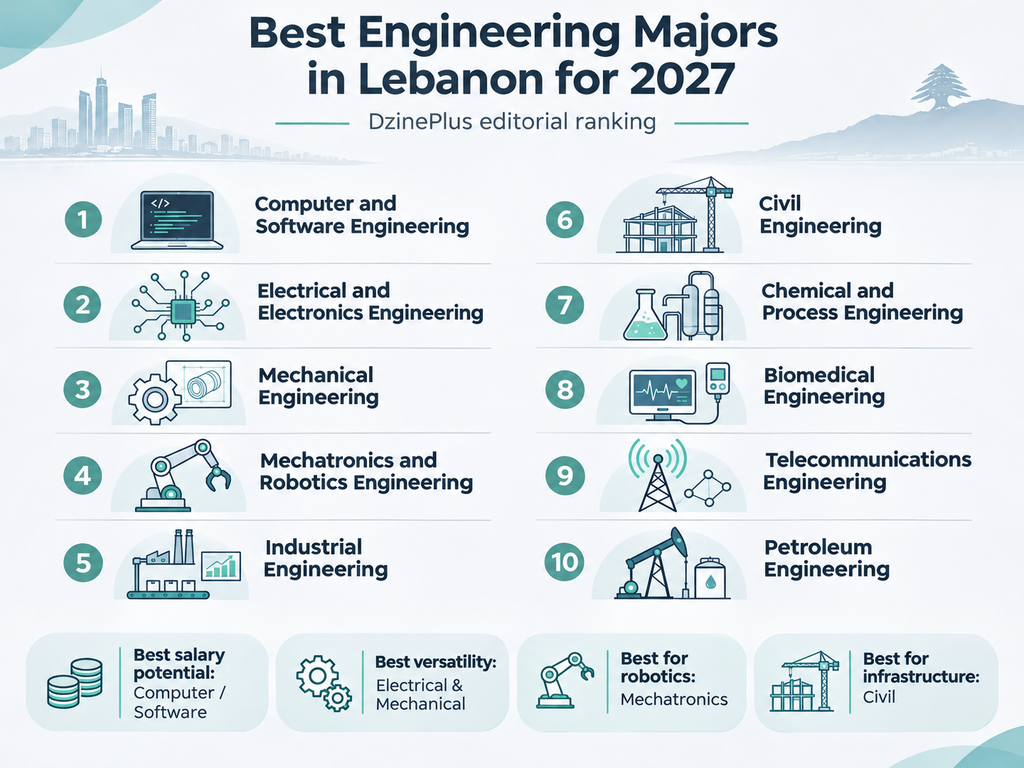
The ten engineering fields ranked highest in DZine⁺’s 2027 assessment are:
- Computer and Software Engineering
- Electrical and Electronics Engineering
- Mechanical Engineering
- Mechatronics and Robotics Engineering
- Industrial Engineering
- Civil Engineering
- Chemical and Process Engineering
- Biomedical Engineering
- Telecommunications Engineering
- Petroleum Engineering
Best overall earning potential: Computer and Software Engineering.
Best balance of technical versatility and career options: Electrical and Mechanical Engineering.
Best for robotics and intelligent machines: Mechatronics Engineering.
Best for construction and infrastructure careers: Civil Engineering.
Best strategy for long-term employability: Combine a recognized engineering qualification with practical experience, digital skills, and continuous learning.
These are editorial recommendations, not statistically measured rankings of Lebanese graduate employment.
Engineering Salaries in Lebanon: 2027 Comparison
The table below uses estimated 2026 monthly salaries from DZine⁺’s Engineering Salaries in Lebanon 2026 research.
| Engineering major | Junior salary (0–2 years) | Mid-level salary (3–5 years) |
|---|---|---|
| Computer / Software | $1,000–$1,800 | $1,800–$3,500 |
| Electrical / Electronics | $800–$1,400 | $1,200–$2,300 |
| Mechanical | $800–$1,400 | $1,200–$2,200 |
| Mechatronics / Automation | $800–$1,400 | $1,300–$2,300 |
| Industrial | $800–$1,300 | $1,200–$2,000 |
| Civil | $700–$1,200 | $1,000–$2,000 |
| Chemical / Process | $700–$1,200 | $1,100–$1,900 |
| Biomedical | Insufficient field-specific data | Insufficient field-specific data |
| Telecommunications | Insufficient field-specific data | Insufficient field-specific data |
| Petroleum | Insufficient field-specific data | Insufficient field-specific data |
Salary methodology: Figures are approximate monthly USD market ranges for locally based employment, not official averages, guaranteed offers, or 2027 salary forecasts. They exclude the separate compensation market for internationally employed remote engineers. Lebanon lacks a sufficiently comprehensive public salary dataset for every individual engineering discipline. We have therefore not invented separate salary ranges for biomedical, telecommunications, or petroleum engineering.
Salary is only one part of the decision. An engineering graduate earning $1,200 in a role with strong training and career progression may have better long-term prospects than someone earning $1,500 in a position with limited advancement.
1. Computer and Software Engineering
Best for: Remote employment, software development, AI, cloud infrastructure, and high earning potential.
Computer and Software Engineering ranks first because of its international career flexibility and comparatively strong salary opportunities.
The International Labour Organization’s October 2026 report, Future Ready: A Labour Market Assessment of Lebanon’s Digital Sector, identifies demand for production-ready software developers, cybersecurity specialists, data professionals, and advanced cloud skills.
The report also identifies a mismatch between university education and employer requirements. A computer-related degree alone is not enough to secure a competitive position.
Potential career paths: Software engineering, backend development, embedded software, cybersecurity, data engineering, machine learning, cloud infrastructure, and DevOps.
AI impact: High task exposure, but also significant new opportunities. AI tools can generate code, write tests, and assist with debugging. Engineers remain responsible for system architecture, security, reliability, validation, and complex integration.
2027 outlook: Strong for graduates with practical development experience. More competitive for candidates who rely only on basic programming knowledge.
Skills to prioritize: Python, JavaScript or TypeScript, SQL, Git, software architecture, testing, cloud platforms, and AI-assisted development.
Verdict: The strongest choice for students prioritizing international mobility and earning potential, provided they genuinely enjoy programming and continuous learning.
2. Electrical and Electronics Engineering
Best for: Power systems, renewable energy, electronics, embedded systems, and industrial automation.
Electrical Engineering offers several distinct career pathways, making it one of the most versatile engineering disciplines in Lebanon.
Graduates can work in building electrical systems, power distribution, solar energy, industrial controls, electronics, and hardware development.
Energy infrastructure remains particularly relevant. Lebanon’s National Renewable Energy Action Plan 2025–2030 documents the expansion of distributed solar photovoltaic installations and identifies continued energy-sector development priorities.
Potential career paths: Power engineer, electrical design engineer, electronics engineer, embedded systems engineer, automation engineer, solar systems engineer, and commissioning engineer.
AI impact: Moderate task exposure. AI can assist with circuit design, calculations, documentation, and simulation, but physical testing, safety, regulatory compliance, and commissioning remain essential.
2027 outlook: Strong versatility, especially for engineers combining electrical fundamentals with programming, electronics, or modern energy systems.
Skills to prioritize: Power systems, PCB design, C/C++, embedded programming, PLCs, electrical protection, and system testing.
Verdict: One of the best choices for students who want a technical degree with several possible specializations.
3. Mechanical Engineering
Best for: Product design, manufacturing, machinery, HVAC, robotics, and physical product development.
Mechanical Engineering remains a broad and adaptable degree. Its applications range from building services and industrial equipment to precision manufacturing and advanced product development.
The greatest opportunities are not necessarily in basic drafting. Engineers who can perform calculations, design assemblies, build prototypes, test mechanisms, and support manufacturing bring more complete capabilities to an employer.
Potential career paths: Mechanical design engineer, product development engineer, manufacturing engineer, HVAC engineer, robotics engineer, maintenance engineer, and project engineer.
AI impact: Moderate task exposure. Generative design, automated CAD features, and simulation assistance can reduce routine work. However, engineering judgment, materials selection, tolerance management, prototyping, and physical validation remain important.
2027 outlook: Strong across multiple industries, although local salaries and opportunities depend heavily on specialization and employer type.
Skills to prioritize: SolidWorks or similar CAD software, GD&T, FEA, design for manufacturing, materials, machining, and mechanical testing.
Verdict: An excellent option for students who enjoy designing and building physical systems. Combining mechanical engineering with automation, electronics, or programming increases career flexibility.
4. Mechatronics and Robotics Engineering
Best for: Robotics, automation, motion control, embedded systems, and intelligent machines.
Mechatronics combines mechanical engineering, electronics, control systems, and programming.
The World Economic Forum’s Future of Jobs Report 2025 identifies robotics and automation among the major technologies expected to transform employment through 2030.
However, global growth in robotics does not automatically translate into a large robotics job market in Lebanon.
Potential career paths: Automation engineer, robotics engineer, control systems engineer, embedded systems developer, machine design engineer, and industrial integration engineer.
AI impact: Mixed. AI increasingly assists programming, simulation, and controls development. At the same time, intelligent automation creates opportunities for engineers who can integrate sensors, actuators, mechanical systems, and software.
2027 outlook: Promising for specialized graduates, but local job opportunities can be narrower than in traditional mechanical or electrical engineering.
Skills to prioritize: PLCs, robotics fundamentals, embedded C/C++, Python, control theory, motor drives, sensors, and industrial communication.
Verdict: A strong choice for students interested in intelligent machines, but it should be supported by substantial hands-on engineering projects.
5. Industrial Engineering
Best for: Manufacturing, operations, logistics, process optimization, and engineering management.
Industrial Engineering focuses on improving how systems operate. Its applications include production lines, supply chains, quality systems, warehouse operations, and business processes.
Its advantage is that the underlying skills apply across several industries rather than depending on one particular technology.
Potential career paths: Industrial engineer, production engineer, process engineer, quality engineer, operations analyst, supply chain specialist, and project manager.
AI impact: Moderate to high task exposure in data analysis, scheduling, reporting, and process documentation. The opportunity lies in using those tools to improve real operational performance.
2027 outlook: A practical option for students interested in both engineering and business operations.
Skills to prioritize: Excel, SQL, Python, Power BI, Lean manufacturing, Six Sigma, operations research, and project management.
Verdict: Particularly suitable for students who enjoy efficiency, systems thinking, data-driven decision-making, and management-oriented career paths.
6. Civil Engineering
Best for: Construction, structural design, infrastructure, project management, and international contracting.
Civil Engineering remains important to Lebanon’s infrastructure, buildings, roads, and rehabilitation needs.
However, it would be misleading to describe the local construction market as automatically booming.
An ILO construction-sector assessment published in October 2026 reports that annual construction activity had contracted by approximately 80% compared with its pre-crisis level. The report identifies future opportunities in rehabilitation, maintenance, reconstruction, and green construction, conditional on investment and recovery.
Potential career paths: Structural engineer, site engineer, infrastructure engineer, quantity surveyor, BIM engineer, construction manager, and project engineer.
AI impact: Moderate task exposure. AI can assist drafting, estimation, document analysis, and design workflows. Engineers remain responsible for structural safety, site conditions, construction supervision, and regulatory obligations.
2027 outlook: Significant long-term relevance, but near-term local opportunities are sensitive to financing, reconstruction activity, and political and economic stability.
Skills to prioritize: Structural analysis, ETABS, SAFE, Revit, BIM coordination, quantity surveying, and construction planning.
Verdict: A valid and established engineering path, especially for students interested in infrastructure or international construction projects. Do not choose it solely because reconstruction may eventually accelerate.
7. Chemical and Process Engineering
Best for: Industrial processes, manufacturing, materials, food production, pharmaceuticals, and process safety.
Chemical Engineering applies chemistry, thermodynamics, transport phenomena, and process engineering to industrial systems.
Its career applications extend beyond oil and gas, including food processing, pharmaceuticals, water treatment, and materials manufacturing.
Potential career paths: Process engineer, production engineer, chemical plant engineer, quality engineer, process safety engineer, and manufacturing specialist.
AI impact: Moderate task exposure. AI can support process optimization, simulation, analysis, and monitoring. Industrial operations still require safety engineering, equipment knowledge, and process validation.
2027 outlook: Technically valuable, but specialized process-engineering positions are less diverse locally than general mechanical, electrical, or software roles.
Skills to prioritize: Process simulation, thermodynamics, instrumentation, quality control, process safety, and industrial automation.
Verdict: A good degree for students interested in industrial science and process engineering, particularly those open to working outside Lebanon.
8. Biomedical Engineering
Best for: Medical equipment, healthcare technology, medical devices, and clinical engineering.
Biomedical Engineering combines engineering principles with medical and biological applications.
Lebanon has an established medical equipment market. According to the U.S. International Trade Administration’s February 2026 country guide, Lebanese medical equipment imports reached approximately $247 million in 2024.
However, equipment imports should not be confused with local medical-device manufacturing employment. An import-dependent market may provide opportunities in installation, technical service, maintenance, and equipment support without creating a similarly large domestic medical-device design industry.
Potential career paths: Clinical engineer, biomedical equipment engineer, medical device service engineer, quality specialist, and medical technology developer.
AI impact: Mixed. AI may assist diagnostic software, imaging workflows, and device development, but safety, equipment reliability, clinical validation, and regulatory requirements remain critical.
2027 outlook: Promising internationally, with a more specialized and potentially narrower local market.
Skills to prioritize: Electronics, instrumentation, medical equipment, sensors, signal processing, programming, and medical device quality systems.
Verdict: Best for students specifically interested in healthcare technology. Research the actual roles available before assuming the degree primarily leads to designing advanced medical devices in Lebanon.
9. Telecommunications Engineering
Best for: Communication networks, wireless systems, telecommunications infrastructure, and connectivity.
Telecommunications Engineering covers the infrastructure that supports mobile communications, data transmission, networks, and connected devices.
Lebanon’s telecommunications sector is undergoing network upgrades. Alfa announced the activation of its 5G service in selected locations on July 30, 2026, with plans for further deployment.
That creates technical work, but a network upgrade does not necessarily indicate a large increase in permanent entry-level engineering positions.
Potential career paths: Telecommunications engineer, RF engineer, network engineer, infrastructure engineer, wireless systems engineer, and network security specialist.
AI impact: Moderate task exposure. Network monitoring, configuration, and optimization can become increasingly automated. Network architecture, security, physical infrastructure, and troubleshooting continue to require skilled engineers.
2027 outlook: Relevant but specialized. Graduates should consider building complementary skills in cloud networking, cybersecurity, and software-defined networks.
Skills to prioritize: Networking, RF systems, Linux, Python, network security, IP protocols, and cloud infrastructure.
Verdict: A reasonable choice for students passionate about communications technology, but broader Computer or Electrical Engineering degrees may offer greater flexibility.
10. Petroleum Engineering
Best for: Oil and gas exploration, reservoir engineering, drilling, and energy-sector careers abroad.
Petroleum Engineering remains a recognized university degree in Lebanon, including at Lebanese American University.
Its primary career pathways are in hydrocarbon exploration, production, reservoir analysis, and related industrial operations.
Lebanon’s offshore exploration activity should not be mistaken for an established domestic oil and gas production industry. TotalEnergies and its partners signed an agreement for exploration of offshore Block 8 in January 2026, following an unsuccessful exploration well in Block 9.
Potential career paths: Petroleum engineer, reservoir engineer, drilling engineer, production engineer, and energy operations specialist.
AI impact: Moderate task exposure. AI can assist geological interpretation, reservoir modelling, and operational optimization. Subsurface uncertainty, engineering validation, and field operations still require specialist knowledge.
2027 outlook: Potentially rewarding internationally, but highly exposed to commodity cycles, investment decisions, and geographic concentration of employment.
Skills to prioritize: Reservoir engineering, drilling systems, fluid mechanics, process engineering, numerical simulation, and energy economics.
Verdict: A specialized degree best suited to students committed to the energy industry and willing to pursue international opportunities. It is not a safe choice based solely on expectations of Lebanese offshore discoveries.
Which Engineering Fields Will AI Affect the Most?
AI will change engineering work, but exposure to AI does not mean that an entire profession will disappear.
The International Labour Organization’s May 2025 research estimated that approximately one in four workers globally were employed in an occupation with some exposure to generative AI. The ILO emphasized that transformation of work is more likely than complete job replacement for most occupations.
For engineering, the more useful distinction is between tasks that can be automated and responsibilities that still require verification, accountability, and technical judgment.
| Engineering activity | Likely AI influence | Remaining engineering responsibility |
|---|---|---|
| Routine coding | High | Architecture, testing, security, reliability |
| Basic CAD modelling | Increasing | Functional design, tolerances, manufacturability |
| Engineering calculations | Increasing | Assumptions, verification, safety factors |
| Technical documentation | High | Accuracy, traceability, compliance |
| Data analysis and reporting | High | Interpretation and operational decisions |
| Physical testing and commissioning | More limited direct automation | Measurements, safety, validation, troubleshooting |
| Complex multidisciplinary systems | AI-assisted | Integration, trade-offs, final accountability |
These are qualitative task-level assessments by DZine⁺, not measured occupation-level automation probabilities.
A software engineer who only performs routine coding may experience more direct AI-driven workflow changes than one who develops complex, secure systems. Similarly, a mechanical engineer who only produces basic CAD models may face more automation pressure than one who can engineer, prototype, test, and manufacture a complete product.
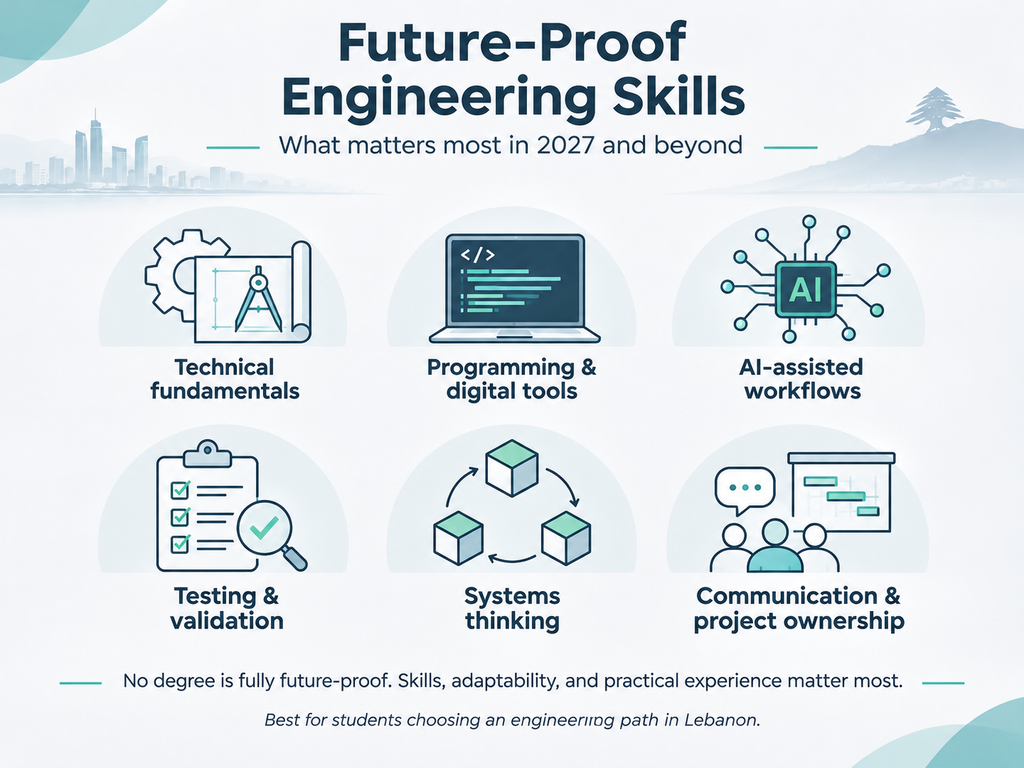
The strongest long-term strategy is not avoiding AI. It is learning to use AI while developing skills that are difficult to automate reliably.
Which Engineering Majors Have the Best Future Beyond 2030?
The World Economic Forum’s Future of Jobs Report 2025 identifies AI and machine learning, software development, robotics, cybersecurity-related roles, and renewable energy engineering among important areas of expected employment growth through 2030.
It also estimates that 39% of workers’ existing skill sets will change or become outdated during the 2025–2030 period.
For Lebanese students, the implications are straightforward:
- Computer Engineering: Develop expertise beyond routine coding, particularly in software architecture, security, cloud systems, and applied AI.
- Electrical Engineering: Combine traditional electrical knowledge with power electronics, embedded systems, renewable energy, and automation.
- Mechanical Engineering: Build capabilities in advanced manufacturing, robotics, simulation, and product development.
- Mechatronics Engineering: Focus on practical systems integration, controls, and intelligent automation.
- Civil Engineering: Strengthen skills in structural engineering, BIM, infrastructure resilience, and sustainable construction.
- Industrial Engineering: Learn data analytics, automation, quality systems, and operations optimization.
Environmental and water engineering also deserves attention, particularly for students interested in sustainability, water infrastructure, waste treatment, and environmental compliance. In Lebanon, these subjects may be offered through Civil and Environmental Engineering degrees or as specializations rather than separate undergraduate majors.
A degree can provide a foundation for decades. Individual software tools and workflows may become outdated within a few years.
Is Engineering Still Worth Studying in Lebanon in 2027?
Yes, for students who have a genuine interest in technical problem-solving and a realistic plan for developing employable skills.
However, students should not assume that graduating with an engineering degree guarantees a well-paid job.
Lebanon’s employment market remains difficult. An ILO survey conducted in May 2026 found that 33% of the 2,485 surveyed private-sector workers who had been employed before the renewed conflict were no longer working at the time of the survey.
That figure covers the surveyed private-sector workers, not engineering graduates specifically.
At the same time, opportunities differ considerably by industry, specialization, employer, and access to international markets.
A student’s choice should consider three questions:
- Can I find a first job or internship in this field? Entry-level opportunities and training quality matter as much as long-term theoretical demand.
- Can this degree help me work abroad or for international clients? Career mobility can substantially expand the available opportunities.
- Will I enjoy developing the skills required? A degree with strong salary potential is a poor investment if the student has little interest in the actual work.
How to Choose an Engineering University in Lebanon
The name of the university matters, but the exact degree program and the quality of its practical training matter more than marketing claims.
Before enrolling, verify:
- Degree recognition: Confirm that the exact qualification is recognized by Lebanon’s relevant authorities and accepted for professional registration where required.
- Program accreditation: Check whether the specific engineering program is accredited by ABET or another applicable recognized accreditation body. ABET accredits individual programs, not entire universities.
- Laboratory access: Look for practical facilities, equipment, engineering software, and technical projects.
- Internships: Ask about industry partnerships and actual student placement opportunities.
- Graduate outcomes: Request recent information on graduate employment, industries, and career progression.
The LAU 2026–2027 academic catalog demonstrates why checking degree names matters. It lists dedicated engineering degrees in several disciplines, while areas such as renewable energy and AI are also available as minors or specializations.
Do not assume that a university advertising an engineering subject offers it as an independent accredited engineering degree.
Frequently Asked Questions
What is the best engineering major in Lebanon for 2027?
Computer and Software Engineering ranks first in DZine⁺’s 2027 assessment because of its comparatively strong salary potential, international mobility, and wide range of technical career paths. Electrical and Mechanical Engineering offer particularly strong alternatives for students interested in physical systems.
Which engineering major pays the highest salary in Lebanon?
Software Engineering has the highest estimated salary ranges among the fields covered by DZine⁺’s 2026 salary research. Local junior software engineers are estimated at approximately $1,000–$1,800 per month, while senior engineers can earn substantially more. International remote employment follows a different compensation market.
Is Mechanical Engineering still worth studying in 2027?
Yes. Mechanical Engineering remains relevant to product development, manufacturing, HVAC, industrial machinery, and automation. Graduates benefit from combining mechanical fundamentals with modern design tools, analysis, manufacturing knowledge, and practical experience.
Will AI replace engineers?
AI is expected to automate or assist with many engineering tasks, but that does not establish that entire engineering professions will disappear. Engineers who understand technical fundamentals, validate results, and take responsibility for complete systems are better positioned to adapt.
Is Mechatronics better than Mechanical Engineering?
Neither is universally better. Mechanical Engineering offers a broader foundation in mechanical systems, manufacturing, and thermal sciences. Mechatronics emphasizes electronics, controls, automation, and programming. The right choice depends on the student’s interests and the actual university curriculum.
Which engineering degree is best for working abroad?
Computer, Software, Electrical, Mechanical, and Civil Engineering all have international career pathways. Software-related roles generally offer greater access to fully remote work, while traditional engineering fields may involve relocation, professional licensing, site work, or country-specific regulations.
Which engineering major is the most future-proof?
No major is future-proof. Electrical, Mechanical, Computer, and Mechatronics Engineering provide broad foundations that can support several specializations. Career resilience depends on technical depth, adaptability, practical experience, and continued learning.
Final Verdict: What Should You Study in 2027?
There is no single engineering major that guarantees the best career in Lebanon.
Choose Computer or Software Engineering if you enjoy programming and prioritize digital careers and international mobility.
Choose Electrical or Mechanical Engineering if you want broad technical foundations and multiple specializations.
Choose Mechatronics if your main interest is robotics, automation, and intelligent machines.
Choose Civil Engineering if you want a career in structures, infrastructure, or construction, while accepting the sector’s economic cycles.
Choose a specialized field such as Chemical, Biomedical, Telecommunications, or Petroleum Engineering when you understand the industry and are comfortable with a more focused career path.
Above all, choose a discipline in which you can develop real expertise.
A capable engineer with practical experience, a strong technical portfolio, and the ability to solve complex problems will often have better prospects than a graduate who chooses a popular degree but never develops the required skills.
About This Research
This guide was prepared by DZine⁺, a Lebanon-based product design and engineering studio.
The assessment considers five factors: Lebanese employment pathways (25%), international and remote career access (25%), earning potential (20%), resilience to AI-driven changes (20%), and flexibility to move between engineering specializations (10%).
The weighting and ranking are editorial judgments. They do not represent a statistical model of graduate employment or a verified probability of obtaining a job.
Salary figures are estimates based on DZine⁺’s existing 2026 salary research. International outlooks are used as indicators of broader industry trends, not predictions of Lebanese job creation.
Sources and References
- International Labour Organization, Future Ready: A Labour Market Assessment of Lebanon’s Digital Sector, October 2026
- International Labour Organization, Rapid Market Assessment of the Construction Sector, published October 2026
- International Labour Organization, Lebanon’s Labour Market in Crisis, July 2026
- International Labour Organization, Generative AI and Jobs: A Refined Global Index of Occupational Exposure, May 2025
- World Economic Forum, Future of Jobs Report 2025, Jobs Outlook
- Lebanese American University, Undergraduate Programs, Academic Year 2026–2027
- ABET, Accredited Program Search
- U.S. International Trade Administration, Lebanon Medical Equipment Market, February 2026
- Alfa, 5G Launch Announcement, July 2026
- Lebanese Center for Energy Conservation, National Renewable Energy Action Plan 2025–2030
- DZine⁺, Engineering Salaries in Lebanon 2026
Research cutoff: November 16, 2026. The 2027 ranking is forward-looking and should be reviewed when new salary, employment, and industry data become available.
About DZine⁺
DZinePlus is a product design and engineering studio based in Lebanon, specializing in product development, mechanical engineering, electronics integration, rapid prototyping, and manufacturing support.
Explore our engineering insights or learn more about our work at dzineplus.com.